

Claude Startups · 2026
Selected
soruLab has been accepted into the 2026 Claude Startups program.
By joining the Claude Startups program, soruLab became part of the global startup ecosystem.
- Claude Startups 2026 member
- Global technology support
Claude Startups · 2026
soruLab has been accepted into the 2026 Claude Startups program.
By joining the Claude Startups program, soruLab became part of the global startup ecosystem.
What a cloze test is, why German exams use the Lückentext format, the five solving rules that work, and how it differs from a C-test or JCloze gap-fill.
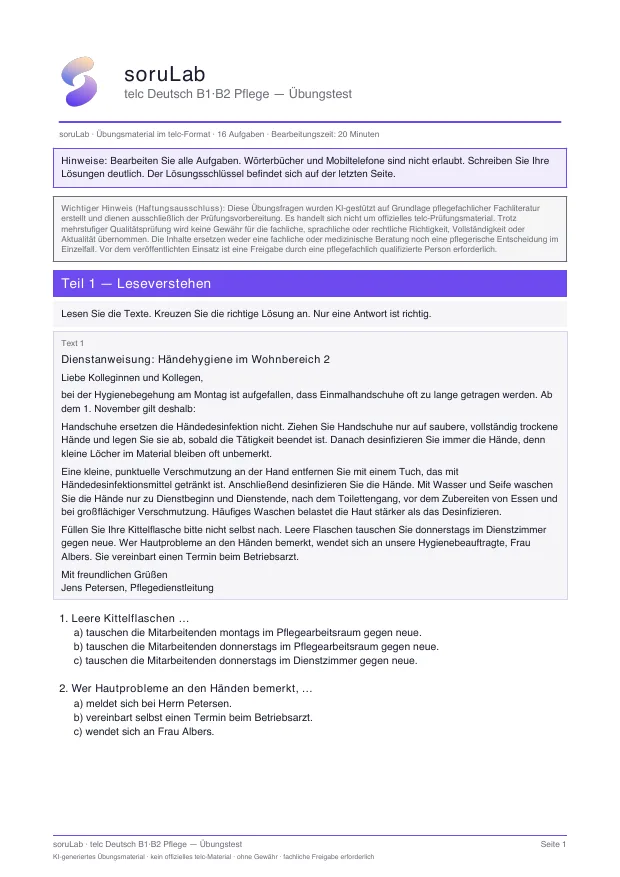
Short answer: a cloze test is a text with words removed on purpose. Your job is to restore them from context. German teaching calls it a Lückentext, or gap text. It appears in almost every serious German exam, because it tests grammar, vocabulary and reading comprehension in one task. You can generate a free German cloze worksheet at any level from A1 to B2+, and every generation gives a new text.
The researcher Wilson Taylor introduced the cloze procedure in 1953. He used it to measure how readable a text is. The method is simple: delete every nth word, ask readers to fill the gaps, then score how much they restore.
Language teaching borrowed the idea and refined it. Modern exam-style cloze tasks rarely delete words mechanically. They use rational deletion: the writer removes specific words to probe specific skills.
If you searched for JCloze, that is the gap-fill module of Hot Potatoes. Teachers used that authoring software to build cloze exercises by hand. It still works, but you must bring your own text and type every gap yourself. The modern equivalent writes a level-appropriate German text and chooses useful gaps in one step.
German suits cloze testing unusually well, because small words and endings carry so much information. A single gap can test whether you know that helfen takes the dative. Another can test that obwohl sends the verb to the end. A third can test the fixed phrase auf die Frage antworten, not an die Frage.
That density explains why cloze-style sections appear across German exams. The Sprachbausteine sections in telc exams are multiple-choice cloze tasks, and telc B1-B2 Pflege includes them. Grammar-in-context gaps also appear throughout Goethe-aligned coursebooks and placement tests.
1. Read the whole text once before you fill anything. Cloze answers are context answers. Information in sentence five often decides a gap in sentence two. A first skim costs 30 seconds. It prevents the most common error: an answer that is grammatically correct but contradicts the text.
2. Classify each gap before you guess. Ask one question: is this gap grammatical or lexical? Grammatical gaps cover articles, prepositions, endings and connectors. They have exactly one right answer, and you can derive it. Lexical gaps need meaning. Classify the gap first, and you halve the options.
3. Use the case-and-verb skeleton. For grammar gaps, find the verb and ask what it governs. In Ich danke ___ Chef, the verb danken takes the dative, so the answer is dem. Fixed verb–preposition pairs decide a large share of German cloze gaps: warten auf, sich freuen über, teilnehmen an.
4. Check connector logic. If the gap is a connector, decide the relationship first: contrast (trotzdem, obwohl), cause (deshalb, weil) or sequence (danach, zuerst). Then check the word order. weil and obwohl send the verb to the end, and deshalb triggers inversion. Wrong word order in the rest of the sentence is the examiner's favourite decoy.
5. Reread the completed text. A correct cloze reads like an ordinary text. If a sentence still feels wrong, one of your "safe" answers is wrong. It is usually an article ending.
Textbook cloze practice fails through memorisation. After two passes you remember the answers, not the reasoning. The fix is volume and variety: a fresh text each time, at your level, with an answer key that explains why.
The German Cloze Test Generator does this. Pick a level from A1 to B2+, then pick a topic. It writes a new German text with rationally chosen gaps, multiple-choice options and a printable answer key. Five generations are free, and it needs no credit card.
If you prepare for a specific exam, pair the generator with level-matched reading: A1, A2, B1 or B2 reading practice. The grammar you drill in gaps then appears again in full texts.
Is a cloze test the same as a fill-in-the-blank exercise? Every cloze test is a fill-in-the-blank, but not every fill-in-the-blank is a cloze. A cloze deletes words from a connected text, so context determines the answers. Isolated single-sentence blanks test one grammar point without context. That is useful, but it is a different and easier skill.
What level should I start at? Start at the level where you can restore 60–70% of gaps on a first attempt. Below that, the text teaches you little. Above 90%, move up. The generator's A1–B2+ levels follow CEFR grammar constraints, so the level you practice matches the level exams expect.
Are cloze tests good preparation for telc or Goethe exams? Yes, with a caveat. Cloze practice builds grammar-in-context skill. The telc Sprachbausteine sections test that skill directly, and every writing task rewards it indirectly. Cloze practice does not replace reading, listening or writing practice. Treat it as the grammar leg of a full preparation plan.
Generate fresh Goethe-style listening sets — real audio, answer key, a new set every time — with the German Listening generator — no repeated material, exam-style formats.
Open the generator →