IELTS reading practice,
generated on demand.
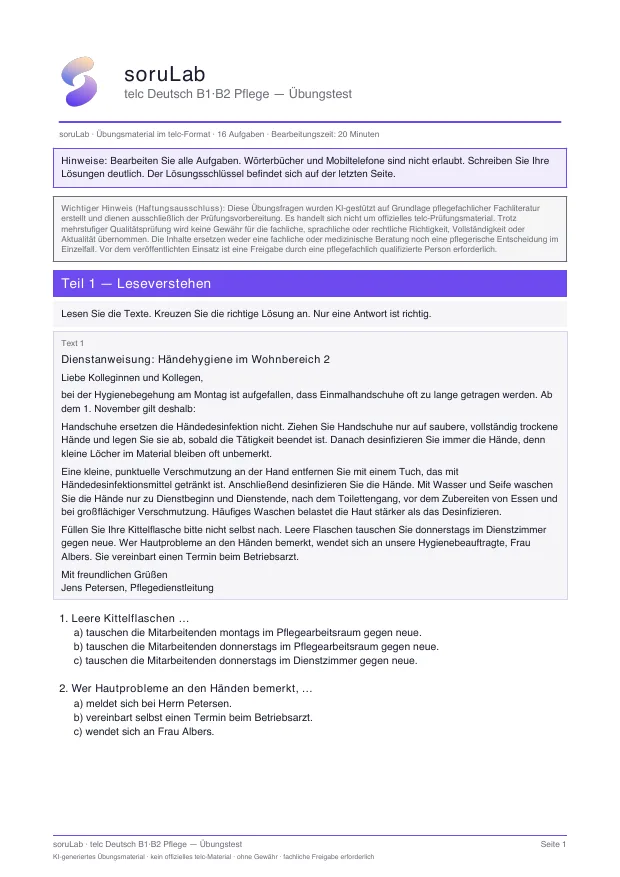
Fresh academic-style passages with paraphrase-based multiple-choice questions — the exact skill the IELTS reading test rewards. Pick any topic, get a new passage every time, print it as an A4 worksheet.
5 free generations · No credit card required
What a generated worksheet looks like
Try a real example — full set
Academic Reading · Multiple choice
Cities are typically several degrees warmer than the countryside that surrounds them, a phenomenon known as the urban heat island effect. Asphalt and concrete absorb solar radiation during the day and release it slowly at night, keeping temperatures high long after sunset. One of the most effective remedies is also one of the oldest: street trees. A mature canopy cools the air both by casting shade and through transpiration, the process by which water evaporates from leaves. Studies in several European cities have recorded afternoon temperature differences of up to four degrees between tree-lined streets and exposed ones nearby.
Yet the benefits of urban greenery are not evenly shared. Wealthier districts tend to enjoy denser canopy cover, while the neighbourhoods that suffer most from extreme heat often have the fewest trees. Municipal planting programmes are attempting to close this gap, but young trees take decades to deliver meaningful cooling, and in dry summers many die before they mature. For city planners, the lesson is an uncomfortable one: planting trees is cheap; keeping them alive is not.
1. What is the main purpose of the first paragraph?
Measures: Main idea — paragraph purpose
2. According to the passage, trees cool the air by
Measures: Detail — definition given in apposition
3. What point does the writer make about municipal planting programmes?
Measures: Inference — implied doubt
4. In the first paragraph, the word 'exposed' is closest in meaning to
Measures: Vocabulary in context — contrast structure
Generated with the soruLab English Workbench — tap an answer to check it. Every worksheet comes with a printable answer key like this.
Every generation is a new passage on a new topic — this is one real set, answer key and all.
Quality control
The checks this practice material passes
- Exam format. Tasks follow the IELTS Academic Reading task types. All items are original material, not copies of exam content.
- Level fit. Passages keep an academic register: complex sentences, nominalisation and hedging.
- One correct answer. Each item has exactly one correct option.
- Distractor quality. Wrong options come from the same word class or the same topic, so they test the skill, not luck.
- Explanations. Each set includes an answer key and an explanation for every item.
A set that fails a check does not reach you — the engine writes a new one. How we write and check questions
IELTS reading is a paraphrase test, not a vocabulary test
Forty questions in sixty minutes leaves ninety seconds per answer. At that speed you cannot afford to re-read: you need to recognise instantly that remedies in the question means ways to reduce in the passage, and that an option which repeats the passage word-for-word is usually bait. That reflex is built one way — by reading academic text you have never seen and checking your mapping against an explained answer key.
soruLab's English Workbench writes a new academic-style passage and question set every time you generate. You choose the topic — science, history, urban planning, health — and get a print-ready A4 worksheet with an answer key, plus optional explanations that show exactly which sentence answers each question. No credits to count, no queues to wait.
Common questions
What does the IELTS Academic Reading test actually measure?
You get three long academic texts and 40 questions in 60 minutes. The core skill is paraphrase recognition at speed: the correct answer almost never repeats the passage word-for-word, it restates it. Question types include multiple choice, matching and True/False/Not Given — and in all of them, matching meaning rather than matching words is what earns the point.
How is generated practice different from Cambridge practice books?
Practice books are excellent but finite — after the second pass you start remembering answers instead of reading. Paraphrase recognition only improves on text you have never seen. soruLab generates a new academic-style passage and a new question set every time, on a topic you pick, so every session is genuinely unseen reading.
Are the passages really at IELTS level?
Passages are written in an academic register — complex sentences, nominalisation, hedging, topic development across paragraphs — the same register IELTS sources from journals, magazines and serious newspapers. You choose the topic and difficulty, and questions are built to test paraphrase and inference, not word-spotting.
Do I get an answer key and explanations?
Yes. Every worksheet is an A4 print-ready PDF with a separate answer key, and you can add an explanations appendix that shows why each answer is correct — which paraphrase in the passage maps to which option.
Have questions before or after purchasing? We're here to help.
Ask us anything about plans, features, or getting started — we'll figure it out together.
IELTS is a registered trade mark of British Council, IDP: IELTS Australia and Cambridge University Press & Assessment. soruLab is an independent study tool and is not affiliated with, endorsed by, or connected to these organisations.