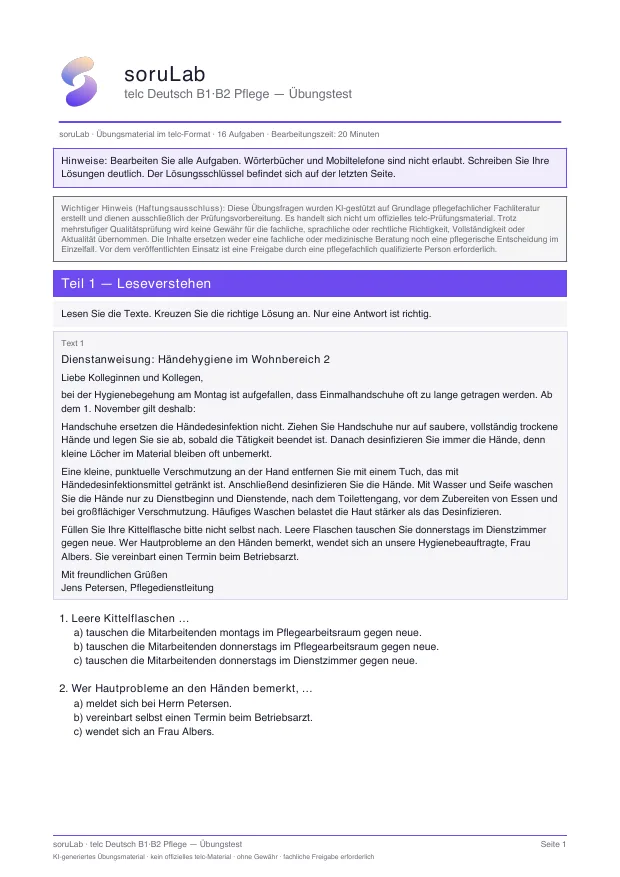
Short answer: telc Deutsch B1·B2 Pflege is a scaled German exam for nursing professionals. It tests reading, listening, language elements, report writing and speaking in nursing contexts. It has a written part and a paired oral part. It does not test clinical skills. The current official oral format is not a simulated patient history or a ward handover.
You can take a free interactive telc Pflege practice test in the exam format. It scores your answers and explains each correct option.
Official exam structure
The current telc exam page gives the following structure:
| Part | Subtest | Official timing |
|---|---|---|
| Written | Listening — 4 parts | 25 minutes |
| Written | Reading — 4 parts + Language Elements — 2 parts | 60 minutes total |
| Written | Writing — 1 report task | 30 minutes |
| Oral | Speaking — 3 parts, usually a pair exam | about 16 minutes + 20 minutes preparation |
You cannot sit the exam as separate partial exams. telc currently offers digital, hybrid and paper-based delivery. Local availability depends on the exam centre.
What the written exam tests
The reading and listening texts reflect everyday nursing work. Official materials use task types such as multiple choice and matching. The writing task uses a report of the kind nursing professionals complete at work.
The 60-minute reading block also contains “Language Elements” (Sprachbausteine). Candidates therefore need nursing vocabulary and enough general grammar control to work accurately under one shared time limit.
What the oral exam actually tests
According to telc’s current description, candidates:
- talk about their experiences and opinions on a topic;
- discuss a controversial topic; and
- give a short presentation.
The oral exam focuses on communication between candidates and with the examiners. Some older or unofficial summaries describe a patient interview or a clinical handover as the exam format. Those tasks are useful workplace-language exercises. Do not treat them as the current official telc speaking tasks.
How the B1-B2 result works
This is a scaled exam. It certifies performance at B1 or at B2. The official mock exam contains the scoring, the weighting and the assessment criteria for speaking and writing. Use those tables to estimate a result. Do not use an unofficial online score converter.
A preparation sequence grounded in the official material
- Download telc’s official free mock exam and audio.
- Complete the mock exam under the published time limits.
- Review your errors by subtest: listening, reading and language elements, report writing, speaking.
- Practise the three official speaking functions: experience and opinion, discussion, short presentation.
- Keep one complete official exam for a final timed rehearsal.
Step 4 matters because clinical role-play alone does not cover the official functions.
telc publishes two official Übungstest versions, not three. Read which PDF is free and which one you must buy before you download anything.
soruLab’s telc B1·B2 Pflege practice gives you additional reading, language-element and nursing-context practice, with a free interactive Übungstest you can start now. It does not replace telc’s official mock exam. It also does not decide whether a recognition authority accepts your certificate.
Is this the certificate your authority requires?
telc defines the exam. The competent German authority defines which evidence it accepts for your recognition case. Use the federal Recognition Finder and ask the named authority before you book. Do not infer nationwide acceptance from an employer, a course provider or a preparation website.
Related guides
- telc Pflege Übungstest 1, 2 and 3: which PDFs are official and free — the free download, the paid one, and the version that does not exist
- How to work as a nurse in Germany: requirements and 5 steps — where this exam fits in the recognition process
- 7 best telc B1-B2 Pflege preparation resources compared
- German for nurses: 60 essential Pflege words and phrases
Official sources
- telc Deutsch B1·B2 Pflege: structure, timings and free preparation material
- Official telc mock examination with scoring and assessment information
- Recognition in Germany: find the authority for an individual case
Exam format checked against telc’s official pages on 17 July 2026. Recognition requirements are separate from exam format and can vary by federal state and individual case.