

Claude Startups · 2026
Selected
soruLab has been accepted into the 2026 Claude Startups program.
By joining the Claude Startups program, soruLab became part of the global startup ecosystem.
- Claude Startups 2026 member
- Global technology support
Claude Startups · 2026
soruLab has been accepted into the 2026 Claude Startups program.
By joining the Claude Startups program, soruLab became part of the global startup ecosystem.
telc Pflege Lesen has 4 parts and 4 text types: emails, care plan, 3 short documents, information text. One strategy per part, 9 practice items inside.
Leseverstehen in telc Deutsch B1·B2 Pflege has four parts, and each part has its own text type. Teil 1 gives short emails, Teil 2 a care plan, Teil 3 three short work documents and Teil 4 one information text. Each text type needs a different reading strategy, so this guide gives one strategy and one new practice text per part.
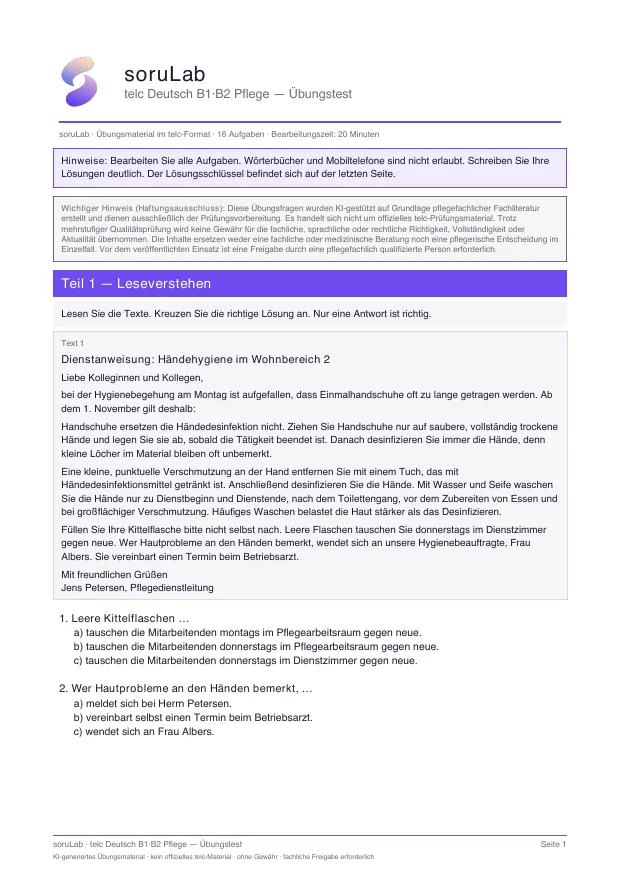
Free practice: solve Übungstest 31 online. It has 16 items in the exam format: three nursing reading texts, Sprachbausteine and nursing cases, in about 20 minutes. You can also download the same Übungstest as a PDF and solve it on paper. No account is needed.
The official telc mock exam (Übungstest 1) shows the four parts. Each correct item gives 1 point, so Lesen has 18 of the 59 points in Hören/Lesen/Sprachbausteine.
| Part | Text type | Task | Items | Points |
|---|---|---|---|---|
| Teil 1 | 4 short emails | Match 6 subject lines (a–f) to the 4 emails | 4 | 4 |
| Teil 2 | 1 care plan (Pflegeplanung) with 8 excerpts (a–h) | Match 5 statements to the excerpts; 1 statement gets x | 5 | 5 |
| Teil 3 | 3 short documents (package insert, circular, regulation) | 2 multiple-choice items (a, b, c) per document | 6 | 6 |
| Teil 4 | 1 semi-formal information text | 3 richtig/falsch statements | 3 | 3 |
Lesen has no separate time limit. Lesen and Sprachbausteine share one block of 60 minutes. Our telc Pflege exam guide shows the full exam structure.
We wrote the practice texts below for this guide. The items are numbered 1 to 9, and the answer key is at the end.
In Teil 1 you read four emails and six subject lines (Betreffzeilen). Two subject lines match no email. You need the main message of each email, not every detail.
Strategy for Teil 1:
Practice text 1 (two emails, three subject lines):
E-Mail 1: Liebe Kolleginnen und Kollegen, ab Montag gilt auf Station 2 ein neuer Dienstplan. Der Frühdienst beginnt um 6:15 Uhr statt um 6:00 Uhr. Der Spätdienst endet unverändert um 21:00 Uhr. Bitte prüfen Sie Ihre Dienste im Intranet und melden Sie Fehler bis Freitag an die Stationsleitung. Viele Grüße, T. Ahmadi
E-Mail 2: Sehr geehrte Frau Novak, vielen Dank für Ihre Bewerbung als Pflegefachkraft. Wir laden Sie zu einem Gespräch am 12. März um 10:00 Uhr ein. Bitte bringen Sie Ihre Anerkennungsurkunde und Ihr Sprachzertifikat mit. Bestätigen Sie den Termin bitte per E-Mail. Mit freundlichen Grüßen, Personalabteilung Klinikum Süd
Subject lines: a) Einladung zum Vorstellungsgespräch · b) Neue Arbeitszeiten im Frühdienst · c) Fortbildung zur Händehygiene am 12. März
In Teil 2 you read five statements and eight excerpts from one care plan. One statement matches no excerpt, and you mark it with an x.
Strategy for Teil 2:
Practice text 2 (four excerpts from the care plan of Herr Keller, three statements):
a) Mobilität: geht mit Rollator; beim Treppensteigen Begleitung durch eine Pflegekraft. b) Ernährung: Diabetesdiät; Blutzucker vor jeder Hauptmahlzeit messen und dokumentieren. c) Haut: Dekubitusrisiko erhöht; Lagerung alle zwei Stunden, Fersen frei lagern. d) Schlaf: schläft schlecht ein; abends keine koffeinhaltigen Getränke, Zimmer abdunkeln.
Select a, b, c, d or x for each statement.
In Teil 3 you read three different documents, for example a circular (Rundschreiben). Each document has two multiple-choice items with three options.
Strategy for Teil 3:
Practice text 3 (a circular, two items):
Rundschreiben Nr. 7: Richten von Medikamenten
Ab sofort richtet die Pflegefachkraft die Medikamente nur noch im Medikamentenraum und nicht mehr im Stationszimmer. Für jeden Patienten wird der Dispenser mit Name, Geburtsdatum und Zimmernummer beschriftet. Nach dem Richten kontrolliert eine zweite Pflegefachkraft die Dispenser und bestätigt die Kontrolle mit ihrem Handzeichen. Auszubildende dürfen Medikamente nur unter Aufsicht richten. Bei Unklarheiten zu einer Verordnung rufen Sie den zuständigen Arzt an, bevor Sie das Medikament ausgeben.
In Teil 4 you read one semi-formal information text. You decide for three statements if they are richtig or falsch. Only the text decides. Your knowledge from work does not count.
Strategy for Teil 4:
Practice text 4 (an information text, two items):
Information für Mitarbeitende: Umgang mit Wertsachen der Bewohner
Bewohnerinnen und Bewohner können Geld und Schmuck im Tresor der Verwaltung hinterlegen. Die Abgabe ist montags bis freitags von 9 bis 15 Uhr möglich. Die Verwaltung stellt eine Quittung aus; eine Kopie kommt in die Bewohnerakte. Pflegekräfte dürfen Wertsachen nicht selbst aufbewahren, auch nicht kurzfristig. Verliert ein Bewohner einen Gegenstand, informieren Sie die Wohnbereichsleitung noch am selben Tag.
Our Lesen Teil 4 guide has a longer practice text with five statements.
Start with Teil 3. It gives 6 points, and the documents are short. Then practise Teil 2, because a forced match costs two points: the wrong excerpt and the missed x.
The telc B1·B2 Pflege practice page lists the free Übungstests, and the test bank has more reading texts in the same nursing contexts.
Lesen has 18 items and 18 points.
No. Lesen and Sprachbausteine share one block of 60 minutes, and you divide the time yourself.
Yes. One statement has no matching excerpt, and you mark it with x. Do not mark two statements with x.
No. soruLab covers Lesen and Sprachbausteine. For the other three subtests, use the free official telc mock exam and its audio files.
| Item | Answer | Why |
|---|---|---|
| 1 | b | E-Mail 1 is about the new Dienstplan and the earlier start of the Frühdienst. Subject line b names both. |
| 2 | a | E-Mail 2 invites Frau Novak to a Gespräch after her Bewerbung, so it is a Vorstellungsgespräch. Line c shares only the date. |
| 3 | b | Blutzucker vor jeder Hauptmahlzeit messen is the value that the nurse checks before meals. |
| 4 | c | Lagerung alle zwei Stunden is a regular change of position. |
| 5 | x | Excerpt d gives measures for sleep: no caffeine, a dark room. No excerpt mentions a medicine. |
| 6 | a | The second sentence lists Name, Geburtsdatum und Zimmernummer. Options b and c change one of the three details. |
| 7 | b | The second nurse kontrolliert die Dispenser and confirms with a Handzeichen. Options a and c are tasks of other people. |
| 8 | richtig | The text says montags bis freitags. That is five days, so the statement is correct. |
| 9 | falsch | The time is correct, but the person is not. The text names the Wohnbereichsleitung, not the Verwaltung. |
Solve Übungstest 31 online with a clock, or download the same Übungstest as a PDF. Note which reading part costs you the most time, and practise that part next week.
Format and item counts checked against the official telc mock exam on 23 October 2026. soruLab is not connected with telc.
Measure your level first — 16 exam-format questions, with the answer key, from telc B1·B2 Pflege Practice — no repeated material, exam-style formats.
Take the free practice test →