

Claude Startups · 2026
Selected
soruLab has been accepted into the 2026 Claude Startups program.
By joining the Claude Startups program, soruLab became part of the global startup ecosystem.
- Claude Startups 2026 member
- Global technology support
Claude Startups · 2026
soruLab has been accepted into the 2026 Claude Startups program.
By joining the Claude Startups program, soruLab became part of the global startup ecosystem.
The 60 German words and phrases nurses actually use on a ward — organised by situation, with English translations, genders, plurals and the classic B1-B2 traps.
Short answer: ward German is narrower than general German, but it forgives far less. You can survive small talk with a wrong article. You cannot chart „Patient klagt über Schmerzen" wrongly, and you cannot mishear nüchtern before a procedure. This list covers the 60 highest-frequency words and phrases in six daily nursing situations. It gives the gender and the plural for each one, because German exams and real documentation both demand them. For the exam that usually accompanies this vocabulary, see our telc B1-B2 Pflege exam guide.
| German | English | Note |
|---|---|---|
| die Pflegefachkraft, ¨-e | qualified nurse | The current official job title; replaces older terms |
| der/die Patient/-in, -en/-nen | patient | der Patient is an n-noun: dem Patienten |
| der/die Arzt/Ärztin, ¨-e/-nen | doctor | On a ward usually der Stationsarzt |
| die Station, -en | ward | auf Station — no article in ward jargon |
| die Schicht, -en | shift | Frühdienst, Spätdienst, Nachtdienst |
| die Übergabe, -n | handover | The key communication ritual between shifts |
| der Angehörige, -n | relative, family member | Adjective noun: ein Angehöriger, die Angehörigen |
| die Bezugspflege | primary nursing | One nurse responsible for specific patients |
| German | English | Note |
|---|---|---|
| der Schmerz, -en | pain | Nearly always plural: Schmerzen haben |
| die Wunde, -n | wound | die Wundversorgung = wound care |
| der Druck | pressure | der Dekubitus = pressure ulcer |
| die Atmung | breathing | die Atemnot = shortness of breath |
| der Kreislauf | circulation | Kreislaufprobleme — a classic ward complaint |
| die Übelkeit | nausea | Mir ist übel — dative construction |
| der Schwindel | dizziness | Mir ist schwindelig |
| das Fieber | fever | Fieber messen = to take a temperature |
| der Blutdruck | blood pressure | den Blutdruck messen |
| der Puls | pulse | den Puls fühlen/messen |
| German | English | Note |
|---|---|---|
| die Grundpflege | basic care | Washing, dressing, positioning |
| jemanden lagern | to position someone | Der Patient wurde gelagert |
| die Mobilisation | mobilisation | mobilisieren — getting the patient moving |
| verabreichen | to administer (medication) | Formal; charting register: Medikament verabreicht |
| die Verordnung, -en | (doctor's) order, prescription | nach ärztlicher Verordnung |
| den Verband wechseln | to change a dressing | der Verbandswechsel |
| die Infusion, -en | IV drip | eine Infusion anlegen |
| die Injektion, -en | injection | subkutan (s.c.), intramuskulär (i.m.) |
| absaugen | to suction | Airway care |
| die Ausscheidung | elimination, excretion | Documentation category |
| der Katheter, - | catheter | einen Katheter legen |
| die Prophylaxe, -n | preventive measure | Dekubitusprophylaxe, Sturzprophylaxe |
German charting is nominal style: verbs become nouns, sentences shrink. The patient complained of pain at night becomes „Patient äußerte nachts Schmerzen" or just „nächtliche Schmerzäußerung". Five patterns cover most entries:
The telc B1-B2 Pflege writing task uses exactly this register: a short nursing report. The exam guide covers the format. Our comparison of preparation resources lists where to practise it for free.
Some word pairs cause real clinical misunderstandings when confused:
Reading a list once creates recognition, not recall. Recall comes from meeting the same vocabulary inside changing texts and tasks, the way the exam and the ward serve it to you.
The telc B1-B2 Pflege test bank puts this word field into ready tests in the exam format. Each answer has an explanation. Start with the free Übungstest.
If you still map the bigger picture of recognition, licence and visa, start with the step-by-step guide to working as a nurse in Germany.
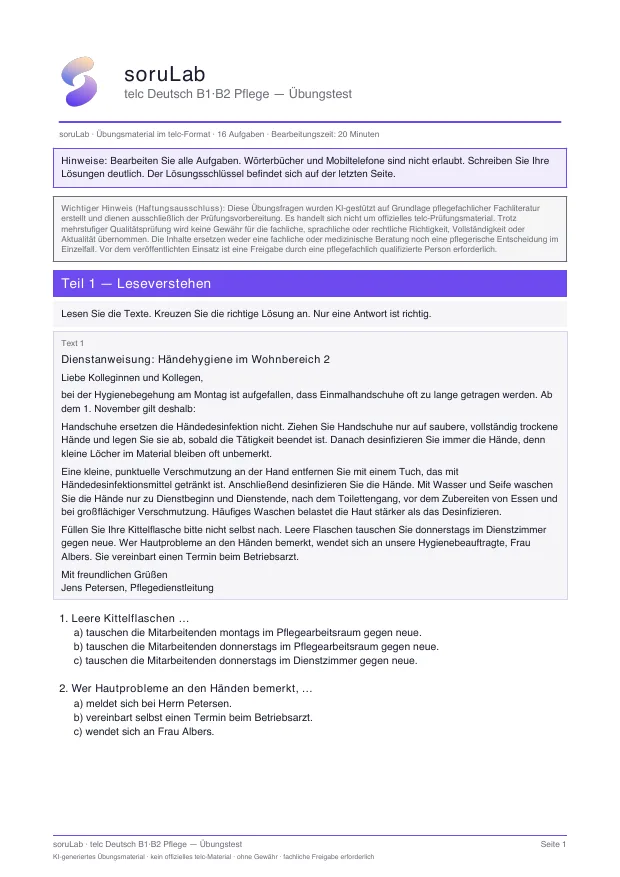
Measure your level first — 16 exam-format questions, with the answer key, from telc B1·B2 Pflege Practice — no repeated material, exam-style formats.
Take the free practice test →