Short answer: nursing is a regulated profession in Germany. A nurse who trained abroad needs three things: recognition of the qualification from the competent authority, a state licence to practise, and proof of German at B2 or above. If the authority finds substantial differences, you can usually close them with an adaptation programme or a knowledge test. The authority and the evidence depend on the federal state where you intend to work.
The labour-market need is real. Current figures describe it better than dramatic estimates do. The Federal Employment Agency reported in May 2026 that 1.76 million people worked in care professions subject to social insurance. Almost one in five was a foreign national.
Step 1: Find the competent recognition authority
The competent body compares your foreign qualification with the German reference profession Pflegefachfrau/Pflegefachmann/Pflegefachperson. You apply to the authority in the federal state where you plan to work. That authority grants recognition, and the recognition is then valid throughout Germany.
Do not rely on a generic checklist from an agency. Open the federal government’s Recognition Finder for nursing professionals. Enter your intended workplace. Then use the authority and the document list that the tool returns for that location.
Step 2: Understand the possible recognition outcome
The authority checks equivalence. It does not give every applicant the same entrance exam. If it finds no substantial differences, and if you meet the other licensing conditions, it can grant recognition. If it finds substantial differences, two compensation routes are usual:
- an adaptation programme (Anpassungslehrgang), or
- a knowledge test (Kenntnisprüfung).
The authority’s notice names the gaps you must close. Germany’s official nursing and care professionals guidance explains the recognition, licence and visa routes for applicants from third countries.
Step 3: Meet the language requirement
The federal guidance states that nurses generally need German at at least B2 CEFR for the licence to practise. Ask the competent state authority two questions: how you must prove that level, and whether it accepts or requires a profession-specific certificate.
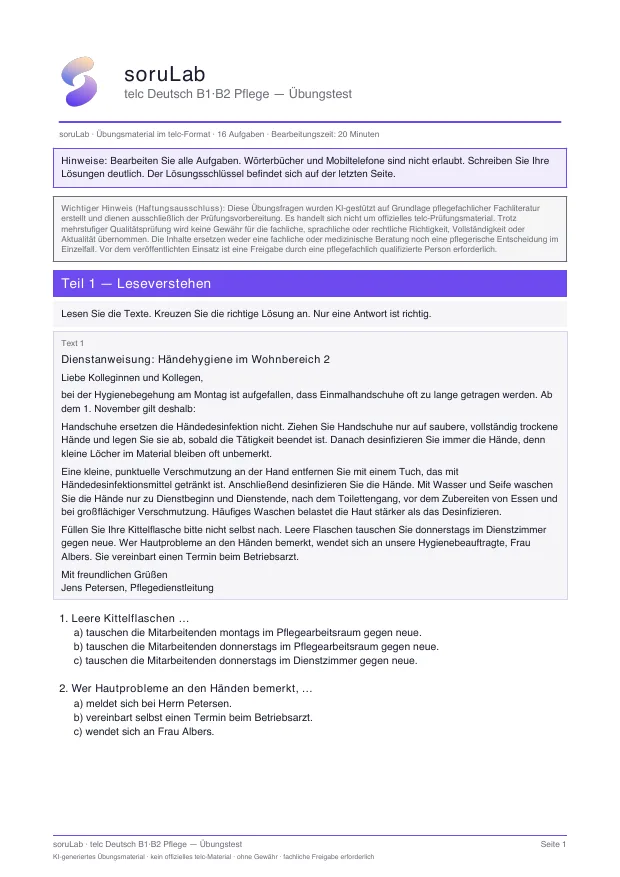
The telc Deutsch B1·B2 Pflege exam is a nursing-language exam. Do not assume that every authority treats one certificate in the same way. Check the Recognition Finder result before you book an exam. If telc Pflege fits your route, our source-checked exam format guide explains what the current official exam contains. A free interactive practice test shows you where you stand before you book.
Step 4: Prepare the document file
The exact list comes from the competent authority, but applicants commonly need:
- proof of identity;
- the nursing qualification and evidence of its content and duration;
- evidence of professional experience, where relevant;
- certified translations or certified copies where requested;
- evidence of health suitability and personal reliability; and
- proof of German when the authority requests it.
Avoid sending irreplaceable originals unless the authority explicitly asks for them. Requirements for certification, translation and document age vary.
Step 5: Choose an employment and immigration route
Applicants from outside the EU/EEA/Switzerland can use different residence routes. The route depends on whether your recognition is complete or a compensation measure remains. The official nursing guidance separates employment after full recognition from residence for a recognition measure.
Triple Win is one government-backed recruitment route. The Federal Employment Agency and GIZ run it. The Federal Employment Agency’s current description names six partner countries: Bosnia and Herzegovina, the Philippines, Tunisia, Indonesia, India and Jordan. Availability and eligibility change. Use the current programme information, not an old country list.
A practical order of work
- Choose the federal state where you intend to work.
- Use the Recognition Finder to identify the competent authority and its current checklist.
- Start the recognition application and your German preparation in parallel, where the authority permits it.
- Read the authority’s notice, then choose an adaptation programme or a knowledge test. Do not choose on a recruiter’s promise.
- Confirm the accepted language evidence before you pay for an exam.
For nursing-specific language practice, soruLab offers telc B1·B2 Pflege practice. It is exam preparation, not a recognition, immigration or licensing service.
Related guides
- telc B1-B2 Pflege exam: official format, timings and free practice test
- telc Pflege Übungstest 1, 2 and 3: which PDFs are official and free
- 7 best telc B1-B2 Pflege preparation resources compared
- German for nurses: 60 essential Pflege words and phrases
- Germany's nursing shortage in 2026: what the official data shows
Official sources
- Make it in Germany: nursing and care professionals from abroad
- Recognition in Germany: Recognition Finder
- Federal Employment Agency: one in five care workers is a foreign national (2026)
- Federal Employment Agency: international recruitment and Triple Win
General information, not legal, immigration or employment advice. Requirements vary by federal state and personal circumstances. The official authority identified by the Recognition Finder is the binding source for an individual case.