Las Posadas (Mexico)
In Mexico, Las Posadas starts on December 16 and ends on December 24. For nine nights, people walk from house to house with candles. They sing a song at each door.
la posada = the inn · la vela = the candle
Title image · 1/5
Grades 2–5 · Christmas Around the World
soruLab
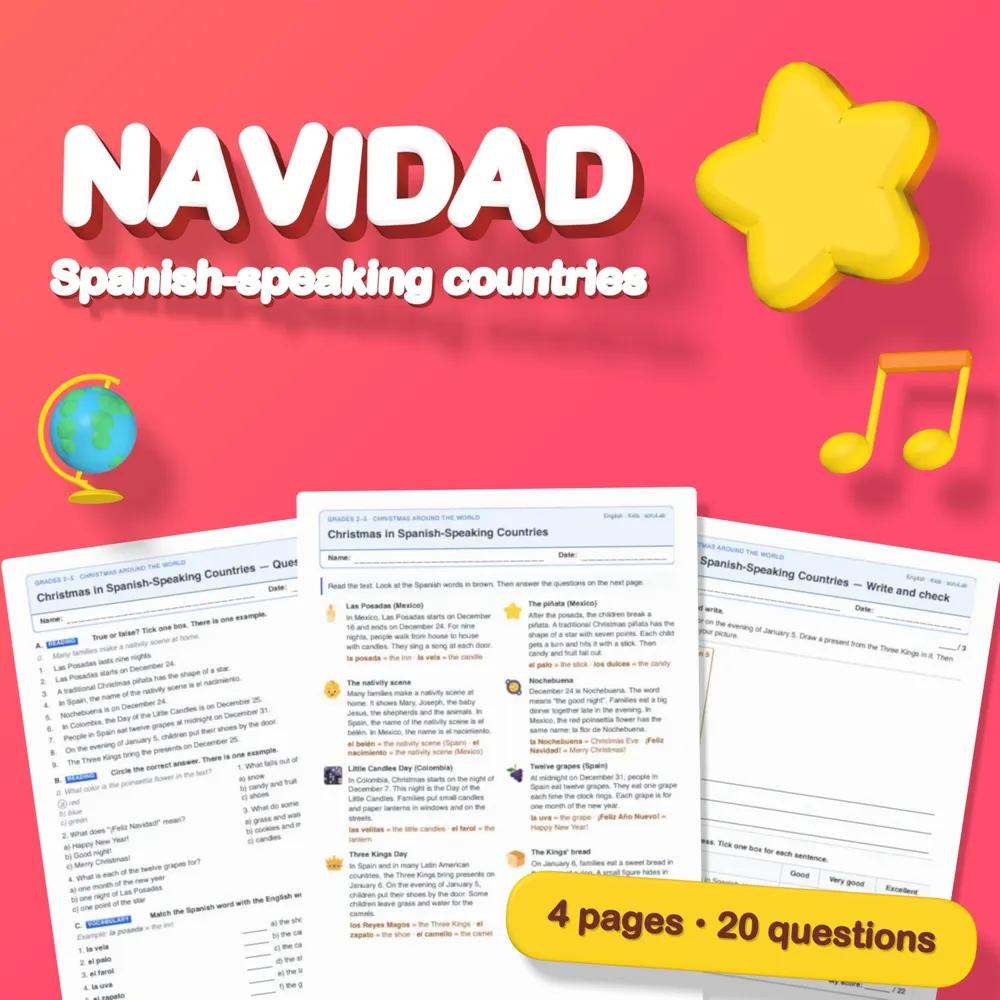
Eight short texts tell about Las Posadas, the piñata, the twelve grapes and Three Kings Day. Each text gives the Spanish words. Then your students answer 20 questions.
Free sample: page 1 with all the texts.
In Mexico, Las Posadas starts on December 16 and ends on December 24. For nine nights, people walk from house to house with candles. They sing a song at each door.
la posada = the inn · la vela = the candle
After the posada, the children break a piñata. A traditional Christmas piñata has the shape of a star with seven points. Each child gets a turn and hits it with a stick. Then candy and fruit fall out.
el palo = the stick · los dulces = the candy
Many families make a nativity scene at home. It shows Mary, Joseph, the baby Jesus, the shepherds and the animals. In Spain, the name of the nativity scene is el belén. In Mexico, the name is el nacimiento.
el belén = the nativity scene (Spain) · el nacimiento = the nativity scene (Mexico)
December 24 is Nochebuena. The word means “the good night”. Families eat a big dinner together late in the evening. In Mexico, the red poinsettia flower has the same name: la flor de Nochebuena.
la Nochebuena = Christmas Eve · ¡Feliz Navidad! = Merry Christmas!
In Colombia, Christmas starts on the night of December 7. This night is the Day of the Little Candles. Families put small candles and paper lanterns in windows and on the streets.
las velitas = the little candles · el farol = the lantern
At midnight on December 31, people in Spain eat twelve grapes. They eat one grape each time the clock rings. Each grape is for one month of the new year.
la uva = the grape · ¡Feliz Año Nuevo! = Happy New Year!
In Spain and in many Latin American countries, the Three Kings bring presents on January 6. On the evening of January 5, children put their shoes by the door. Some children leave grass and water for the camels.
los Reyes Magos = the Three Kings · el zapato = the shoe · el camello = the camel
On January 6, families eat a sweet bread in the shape of a ring. A small figure hides in the bread. In Mexico, the person with the figure gives a party for the family on February 2. This is the last Christmas celebration in Mexico.
la rosca de Reyes = the Kings' bread (Mexico) · el roscón de Reyes = the Kings' bread (Spain)
4 A4 pages. You pay $3 one time. The PDF comes by email. Licence: one teacher, their own classes.