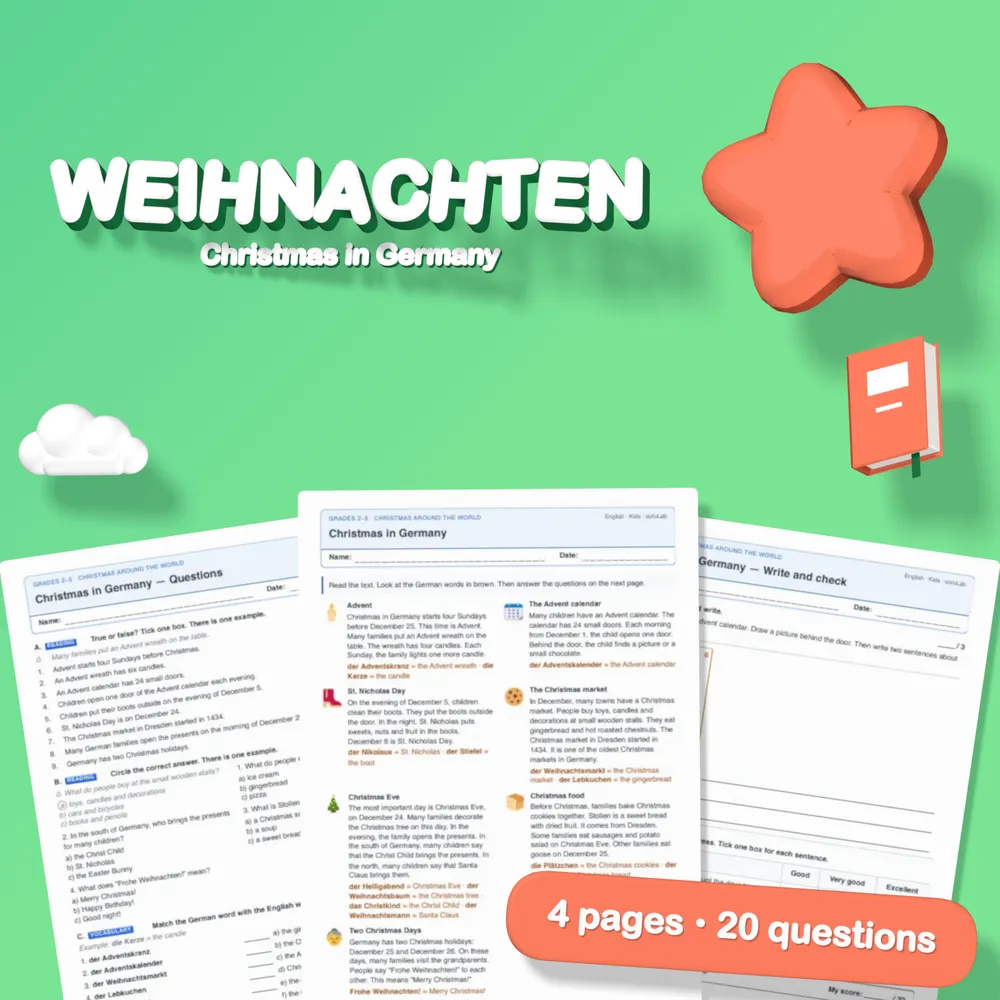
Christmas in Germany Reading Pack: title image

Title image · 1/5

Grades 2–5 · Christmas Around the World

Christmas in Germany: a reading pack

soruLab

Seven short texts tell about Advent, St. Nicholas Day, the Christmas market and Christmas Eve. Each text gives the German words. Then your students answer 20 questions.

Free sample: page 1 with all the texts.

The texts (free sample)

Advent

Christmas in Germany starts four Sundays before December 25. This time is Advent. Many families put an Advent wreath on the table. The wreath has four candles. Each Sunday, the family lights one more candle.

der Adventskranz = the Advent wreath · die Kerze = the candle

The Advent calendar

Many children have an Advent calendar. The calendar has 24 small doors. Each morning from December 1, the child opens one door. Behind the door, the child finds a picture or a small chocolate.

der Adventskalender = the Advent calendar

St. Nicholas Day

On the evening of December 5, children clean their boots. They put the boots outside the door. In the night, St. Nicholas puts sweets, nuts and fruit in the boots. December 6 is St. Nicholas Day.

der Nikolaus = St. Nicholas · der Stiefel = the boot

The Christmas market

In December, many towns have a Christmas market. People buy toys, candles and decorations at small wooden stalls. They eat gingerbread and hot roasted chestnuts. The Christmas market in Dresden started in 1434. It is one of the oldest Christmas markets in Germany.

der Weihnachtsmarkt = the Christmas market · der Lebkuchen = the gingerbread

Christmas Eve

The most important day is Christmas Eve, on December 24. Many families decorate the Christmas tree on this day. In the evening, the family opens the presents. In the south of Germany, many children say that the Christ Child brings the presents. In the north, many children say that Santa Claus brings them.

der Heiligabend = Christmas Eve · der Weihnachtsbaum = the Christmas tree · das Christkind = the Christ Child · der Weihnachtsmann = Santa Claus

Christmas food

Before Christmas, families bake Christmas cookies together. Stollen is a sweet bread with dried fruit. It comes from Dresden. Some families eat sausages and potato salad on Christmas Eve. Other families eat goose on December 25.

die Plätzchen = the Christmas cookies · der Stollen = the Christmas bread

Two Christmas Days

Germany has two Christmas holidays: December 25 and December 26. On these days, many families visit the grandparents. People say “Frohe Weihnachten!” to each other. This means “Merry Christmas!”

Frohe Weihnachten! = Merry Christmas!

What is in the full pack

  • 7 short texts with the German words
  • 20 questions: 9 true or false, 4 multiple choice, 6 word matches and a drawing task
  • A worked example and a points box for each task, as in Cambridge-style tests
  • A self-check page (“Check your progress”) and the total score: 22 points
  • The answer key with the points

4 A4 pages. You pay $1.50 one time. The PDF comes by email. Licence: one teacher, their own classes.

More printable packs

Questions from teachers

Which grades is this pack for?
The pack is for grades 2 to 5. The texts use short sentences in the present tense. Your students do not need to know German.
What is in the full pack?
The PDF has 4 A4 pages. Page 1 has seven short texts about Christmas in Germany. Pages 2 and 3 have 20 questions with a worked example for each task, a self-check and the total score. Page 4 has the answer key with the points.
What is free?
Page 1 with all the texts is free. Download it on this page. The full pack costs $1.50 one time, and the PDF comes to your email.
Can I use it for a Christmas Around the World unit?
Yes. Use the pack as the Germany lesson of your unit. The texts tell about Advent, St. Nicholas Day, the Christmas market, Christmas Eve, Christmas food and the two Christmas days.