Sprachbausteine (Language Elements) is the gap-fill part of the telc Deutsch B1·B2 Pflege exam. It has 2 parts, and each part uses a nursing report with gaps. This guide gives the official format and 12 new practice items with answers and clues.
telc Pflege Sprachbausteine: the format
The telc exam page lists Language Elements with 2 parts. The telc tips for exam preparation describe each part:
| Feature | Teil 1 | Teil 2 |
|---|---|---|
| Text | 1 report or part of a report | 1 other report |
| Gaps | 8 | 10 |
| Options | 1 word box with 10 words; each word once, 2 words stay unused | 3 options for each gap |
| What telc tests | links in the text (time, cause) | vocabulary of nursing reports (Fachlexik) |
| Points | maximum 8 | maximum 10 |
Sprachbausteine has no separate time limit. It shares one 60-minute block with the 4 reading parts. For the full exam structure, read our telc B1-B2 Pflege exam guide.
Sprachbausteine is not a grammar test
telc says this directly: Sprachbausteine does not check grammar rules. Teil 1 tests how the sentences of a report connect. Teil 2 tests the exact meaning of report vocabulary.
Grammar still gives you clues. The explanations below use 4 types of clue: connector, word order (Verbstellung), preposition and case (Kasus).
Teil 1 practice: a late-shift report with 6 gaps
We wrote this report for this guide. It has 6 gaps and 8 words, so 2 words stay unused, as in the exam.
Word box: außerdem · damit · denn · deshalb · nachdem · obwohl · trotzdem · weil
Pflegebericht Spätdienst, Zimmer 7, Herr Yilmaz (78)
Herr Yilmaz klagte um 15 Uhr über starke Schmerzen im rechten Knie. (1) ___ informierte ich die diensthabende Ärztin. Sie ordnete 500 mg Paracetamol an. (2) ___ ich ihm das Medikament um 15:20 Uhr verabreicht hatte, fragte ich um 15:50 Uhr erneut nach den Schmerzen. Der Patient gab nur noch leichte Schmerzen an.
Am Nachmittag wollte er nicht aufstehen, (3) ___ er sehr müde war. (4) ___ habe ich ein Kissen unter das rechte Knie gelegt, (5) ___ das Bein entlastet ist. Herr Yilmaz hat bis 18 Uhr nur 400 ml getrunken, (6) ___ ich ihn mehrmals zum Trinken aufgefordert habe. Bitte achten Sie im Nachtdienst auf die Trinkmenge.
Teil 1 answers and clues
1. deshalb. The pain is the cause, and the call to the doctor is the result. After deshalb, the verb comes next: deshalb informierte ich.
2. nachdem. The times show the order of events: first the medicine, then the second question. Nachdem takes the verb at the end and often the past perfect (verabreicht hatte).
3. weil. The second clause gives the reason. The verb war is at the end of the clause, so the gap needs a subordinating connector.
4. außerdem. The pillow is one more action, not a result of the tiredness. After außerdem, the verb comes next: außerdem habe ich.
5. damit. The clause gives the purpose of the pillow. The verb ist is at the end, so damit fits here.
6. obwohl. The nurse asked the patient to drink, but he drank little. This is a contrast. The verb habe is at the end of the clause.
Denn and trotzdem stay unused.
Teil 2 practice: an early-shift report with 6 gaps
In Teil 2, each gap has 3 options, and only one option is correct. This practice report has 6 gaps.
Pflegebericht Frühdienst, Zimmer 12, Frau Lange (82), 1. Tag nach Knie-Operation links
Beim Wecken klagte Frau Lange (7) ___ Übelkeit. Nach Rücksprache mit Dr. Kaya habe ich ihr um 7:30 Uhr ein Medikament gegen Übelkeit (8) ___. Die Wunde am Knie ist (9) ___: keine Rötung, keine Schwellung. Wegen der Infusion am rechten Arm isst sie mit der linken Hand und kommt damit gut (10) ___. Wegen der Bettruhe haben wir sie alle zwei Stunden (11) ___, um einen Dekubitus zu vermeiden. Die Tochter wurde telefonisch über die geplante Verlegung in die Reha (12) ___.
| Gap | a | b | c |
|---|---|---|---|
| 7 | an | über | für |
| 8 | verordnet | vertragen | verabreicht |
| 9 | reizlos | reizbar | entzündet |
| 10 | heraus | nach | zurecht |
| 11 | umgezogen | umgelagert | umgestellt |
| 12 | informiert | erklärt | gemeldet |
Teil 2 answers and clues
7. b) über. The verb klagen takes the preposition über with the accusative case: über Übelkeit klagen. The option an belongs to a different verb: an einer Krankheit leiden.
8. c) verabreicht. The nurse gives the medicine to the patient. Report vocabulary uses verabreichen for this action.
9. a) reizlos. Reizlos describes a wound with no signs of infection. The text after the colon confirms it: no redness, no swelling. Reizbar describes a person who gets angry fast.
10. c) zurecht. The verb is zurechtkommen mit: to manage with something. Here, damit replaces mit der linken Hand.
11. b) umgelagert. Umlagern means to change the position of a patient in bed. Umziehen means to change clothes.
12. a) informiert. The structure is jemanden über etwas informieren. The person is the accusative object, and über introduces the topic.
Why the wrong options look right
The wrong options in Sprachbausteine are not random. Each wrong option has a real connection to the correct answer. These 3 items show the most common traps.
Gap 3: denn has the same meaning as weil
Denn also gives a reason, so it looks correct. The difference is word order. After denn, the verb stays in second position: denn er war sehr müde. In gap 3, the verb war is at the end of the clause. Only weil fits that word order.
Gap 6: trotzdem has the same meaning as obwohl
Both words express a contrast. Trotzdem is an adverb, and the verb comes directly after it: Trotzdem hat er nur 400 ml getrunken. In gap 6, the verb habe is at the end. This word order needs the connector obwohl. If you check only the meaning, you can choose either word.
Gap 8: verordnet is correct vocabulary in the wrong role
Verordnen is a real word in every patient file. The doctor prescribes (verordnet) the medicine, and the nurse gives (verabreicht) it. In gap 8, the subject ich is the nurse, so verordnet is the wrong action.
How to work through Sprachbausteine in the exam
Use these steps for each report:
- Read the full report once before you fill a gap.
- For each gap, find the position of the verb in the clause.
- In Teil 1, decide the link: time, cause, purpose, contrast or addition.
- In Teil 2, read the words before and after the gap for a fixed preposition.
- If a gap is difficult, go to the next gap and come back later.
- In Teil 1, cross out each word from the box after you use it.
Step 5 comes from the telc tips. In Teil 1, fewer words remain in the box at the end, so a difficult gap becomes easier.
Practise Sprachbausteine with soruLab
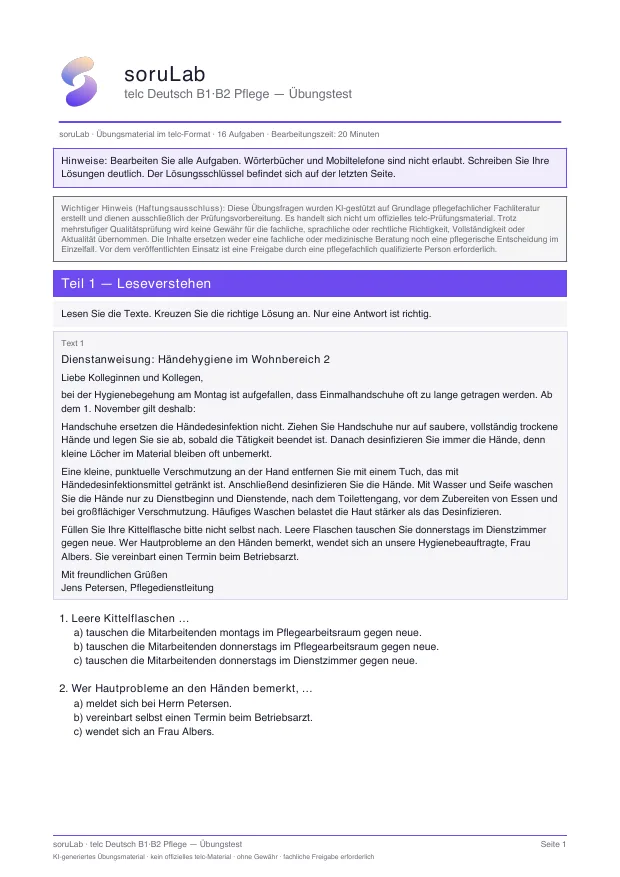
The free Übungstest has 16 items, and 6 of them are Sprachbausteine items. It scores your answers and explains each correct option.
- Take the free Übungstest for Lesen, Sprachbausteine and Fallbeispiele
- Open the Pflege test bank for complete practice tests in the exam format
- See the full written exam format on the telc Pflege practice page
- Practise Lesen Teil 4 with a richtig/falsch text
soruLab practice does not replace telc's official mock exam. Use the official mock exam on telc.net for a timed rehearsal.
Your next step
Open the free Übungstest and go to the 6 Sprachbausteine items. For each gap, write down the clue first: connector, word order, preposition or case.
Official sources
- telc Deutsch B1·B2 Pflege: exam structure and free mock exam
- telc Deutsch B1·B2 Pflege: tips for exam preparation (PDF, German)
Format checked against telc's official exam page and the telc tips for exam preparation on 7 October 2026. The practice reports and items are original soruLab material.