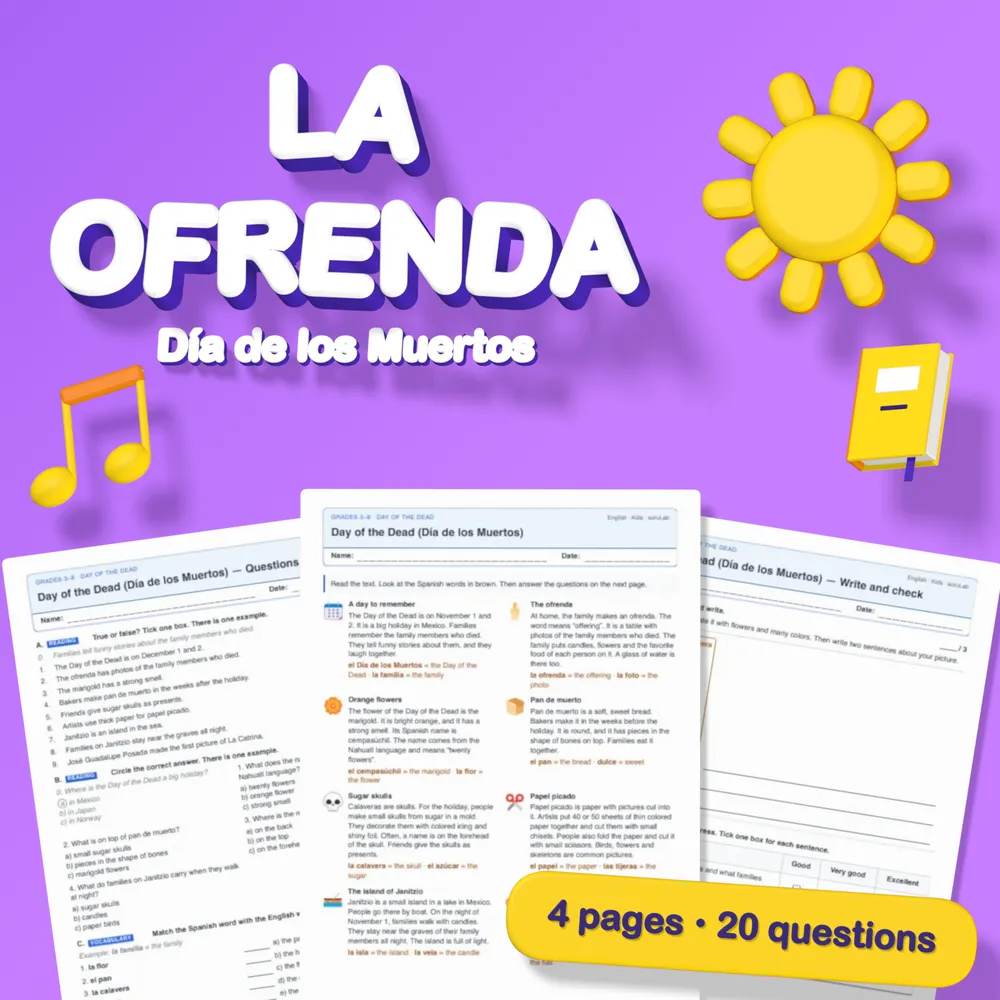
Day of the Dead (Día de los Muertos) Reading Pack: title image

Title image · 1/5

Grades 3–6 · Day of the Dead

Day of the Dead (Día de los Muertos): a reading pack

soruLab

Eight short texts tell about the ofrenda, the marigold flowers, sugar skulls and papel picado. Each text gives the Spanish words. Then your students answer 20 questions.

Free sample: page 1 with all the texts.

The texts (free sample)

A day to remember

The Day of the Dead is on November 1 and 2. It is a big holiday in Mexico. Families remember the family members who died. They tell funny stories about them, and they laugh together.

el Día de los Muertos = the Day of the Dead · la familia = the family

The ofrenda

At home, the family makes an ofrenda. The word means “offering”. It is a table with photos of the family members who died. The family puts candles, flowers and the favorite food of each person on it. A glass of water is there too.

la ofrenda = the offering · la foto = the photo

Orange flowers

The flower of the Day of the Dead is the marigold. It is bright orange, and it has a strong smell. Its Spanish name is cempasúchil. The name comes from the Nahuatl language and means “twenty flowers”.

el cempasúchil = the marigold · la flor = the flower

Pan de muerto

Pan de muerto is a soft, sweet bread. Bakers make it in the weeks before the holiday. It is round, and it has pieces in the shape of bones on top. Families eat it together.

el pan = the bread · dulce = sweet

Sugar skulls

Calaveras are skulls. For the holiday, people make small skulls from sugar in a mold. They decorate them with colored icing and shiny foil. Often, a name is on the forehead of the skull. Friends give the skulls as presents.

la calavera = the skull · el azúcar = the sugar

Papel picado

Papel picado is paper with pictures cut into it. Artists put 40 or 50 sheets of thin colored paper together and cut them with small chisels. People also fold the paper and cut it with small scissors. Birds, flowers and skeletons are common pictures.

el papel = the paper · las tijeras = the scissors

The island of Janitzio

Janitzio is a small island in a lake in Mexico. People go there by boat. On the night of November 1, families walk with candles. They stay near the graves of their family members all night. The island is full of light.

la isla = the island · la vela = the candle

La Catrina

La Catrina is a famous skeleton lady with a big hat. The Mexican artist José Guadalupe Posada made the first picture of her more than 100 years ago. Today, many people dress like La Catrina for the holiday.

el esqueleto = the skeleton · el sombrero = the hat

What is in the full pack

  • 8 short texts with the Spanish words
  • 20 questions: 9 true or false, 4 multiple choice, 6 word matches and a drawing task
  • A worked example and a points box for each task, as in Cambridge-style tests
  • A self-check page (“Check your progress”) and the total score: 22 points
  • The answer key with the points

4 A4 pages. You pay $3 one time. The PDF comes by email. Licence: one teacher, their own classes.

More printable packs

Questions from teachers

Which grades is this pack for?
The pack is for grades 3 to 6 and for beginner Spanish classes. The texts use short sentences in the present tense. Your students do not need to know Spanish.
What is in the full pack?
The PDF has 4 A4 pages. Page 1 has eight short texts about the Day of the Dead. Pages 2 and 3 have 20 questions with a worked example for each task, a self-check and the total score. Page 4 has the answer key with the points.
What is free?
Page 1 with all the texts is free. Download it on this page. The full pack costs $3 one time, and the PDF comes to your email.
Which topics are in the texts?
The texts tell about the dates of the holiday, the ofrenda, the marigold flowers and pan de muerto. They also tell about sugar skulls, papel picado, the island of Janitzio and La Catrina. Each text gives two Spanish words with the English meaning.
Can I use the pack in a public school?
Yes. The texts describe the family tradition: photos, flowers, food and stories. You can use the pack in a social studies class or in a Spanish class.